Episode 1
If They Could Speak
The Story
I am arriving on an island somewhere far away from the rest of civilization. This is not Earth. The landscape is familiar in many ways, but the colors of the sky and sea leave no doubt that we are on another planet.
I’m travelling as part of a scientific expedition consisting of specialists from different disciplines. There are eight or ten other people aboard my shuttle, and three such craft have been sent to investigate the island.
Our transport is angular and rather blocky, reminiscent of the science-fiction spacecraft imagined in the 1980s. It has no propellers or obvious wings, just small jet-like engines mounted at its corners that produce surprisingly little noise.
It is early morning when we approach the coastline.
The shore stretches for perhaps three kilometers before disappearing into the distance, while the island itself continues much farther inland. Most of the coast consists of a broad sandy beach, beyond which a dense tropical forest begins almost immediately. There are no familiar palm-lined resorts or dramatic cliffs, just an uninterrupted expanse of wilderness.
The sea below is somewhat murky, its waters tinted brown rather than the usual blue-green. Above it, the sky has an unusual beige color, not unlike the dusty atmosphere shown in photographs of Mars. Closer to the horizon, however, the rising sun introduces a beautiful purplish hue.
The light is soft, the air fresh but not cold. There are no distinctive animal calls or other sounds to suggest anything particularly unusual about this place.
Our three craft descend toward a relatively small, flat clearing beside what appears to have once been a modest port. The ground is covered in short vegetation, making it suitable for landing. The port itself is abandoned, its remaining structures showing the effects of many years without maintenance.
In fact, everything we can see suggests that people have not been here for decades.
And that is precisely why we have come.
This island was once home to a thriving human colony. Then, several decades ago, all contact with its inhabitants suddenly ceased. No warning, no final transmission, no explanation. The colony’s remoteness and the distances involved have meant that only now has an expedition arrived to investigate.
Nothing has been heard from them in all that time.
Our mission is to establish what happened.
After landing, we divide into pairs, each assigned to investigate a different part of the island. We have until sunset to collect as much information as possible before returning to the landing site and departing together.
My exploration partner and I are botanists, or perhaps more broadly naturalists. Our particular interest lies in the relationship between the island’s vegetation and the vanished settlers.
My colleague is a man in his late thirties, solidly built rather than particularly athletic, with a resilient, practical appearance. I remember brownish or perhaps reddish hair, and something about him wearing glasses, although their exact appearance escapes me.
We know each other well professionally. We’ve worked together on numerous expeditions, and while I wouldn’t call us particularly close friends, there is a comfortable familiarity and mutual trust between us.
We wear specialist field clothing: black work trousers with red accents, lightweight jackets left unzipped, and ordinary checkered shirts underneath. We carry compact scientific equipment, sampling containers and advanced handheld devices that serve as cameras and computers.
We set off along a narrow path leading into the forest.
The vegetation is thick and lush, closer to a tropical jungle than a temperate woodland, though without many of the familiar species one would expect. The trail is barely visible in places, gradually being reclaimed by the surrounding plants.
After perhaps an hour or two of walking, we arrive at a small clearing.
There, almost completely surrounded by vines, shrubs and young trees, stands an old silver camper.
Its rounded metallic body reminds me of the futuristic American travel trailers from the 1950s. Despite its apparent age, the exposed metal retains an unusual shine.
The door is open.
Outside, two little girls, perhaps five to ten years old, are playing together, chasing each other and laughing.
This is quite a surprise.
We call out a friendly greeting from the edge of the clearing.
The children stop, stare at us for a moment, and then run screaming into the camper.
Almost immediately, a man in his thirties appears at the doorway. He’s wearing jeans, a simple shirt and a large straw hat. Behind him stands a woman, presumably his wife, dressed in a worn but rather pleasant dark dress decorated with flowers.
The man seems genuinely shocked to see us. He’s visibly uncomfortable, perhaps even frightened, but not openly hostile.
We introduce ourselves and explain that we’re investigating the disappearance of the colony.
Can he tell us what happened? Where have all the other inhabitants gone?
His response is rather strange.
Speaking with an unfamiliar accent, he explains that he and his wife have lived here since they were about five years old. They have essentially grown up alone in the forest, surviving on whatever it provides. They remember little about the original settlement and claim never to have encountered anyone else.
What strikes me is his peculiar emotional restraint. He answers our questions politely enough, but there is an underlying tension, as though he would very much prefer us to leave.
At the time, I don’t find this particularly suspicious. I assume that encountering complete strangers after so many years of isolation must be an overwhelming experience.
We attempt to photograph the family and their surroundings, but the man suddenly becomes unusually firm.
He insists that we take no pictures of his family or the forest, and asks us not to share such images with the outside world.
It’s an odd request, but we have no intention of upsetting him.
We put away our devices and instead ask whether he knows the location of the old settlement.
He points us north.
There are still buildings about thirty minutes’ walk in that direction, he tells us.
We thank him and continue on our way.
By early afternoon, we arrive at what remains of the colony.
The settlement has a distinctly utilitarian, almost utopian-socialist appearance. Several concrete residential blocks stand arranged around communal spaces, their proportions and repetitive façades reminiscent of Soviet-era housing developments.
Decades of unchecked vegetation have transformed the entire area.
Trees grow between the buildings. Vines climb the walls, and creepers cover what were once paved paths and open spaces. In places, the concrete façades are still visible, including the painted identification numbers on the sides of individual blocks.
Despite the extensive overgrowth, something about the place suggests that its abandonment was not gradual.
It reminds me of the images I’ve seen of Chernobyl and Pripyat: an environment in which ordinary life appears to have stopped abruptly, perhaps over just a few days, leaving nature to reclaim everything that humanity had constructed.
There are scattered signs of the former inhabitants—an occasional metal container, a weathered plastic object, perhaps the rusted remains of a vehicle farther away.
But surprisingly little ordinary rubbish.
We don’t enter any of the apartments or abandoned vehicles. Our attention remains on the vegetation growing throughout the spaces between the buildings.
Eventually, we come upon an old playground.
There are the familiar metal climbing structures of my childhood: a rocket, a globe, a slide, and a sandbox. Their paint has mostly flaked away, exposing corroded metal beneath.
Beside the playground stands the skeleton of a small greenhouse.
Curved metal supports still mark its original shape, but the transparent plastic covering has long since deteriorated. Only a few torn, sun-bleached fragments remain attached to the frame.
Interestingly, the soil inside the greenhouse is relatively clear of vegetation.
My colleague notices something.
Lying near one of the metal supports is a piece of old wood, a branch with most of its bark stripped away.
On its surface grows a peculiar moss.
At first glance, it appears bluish-green, but as we approach, its coloration changes with the light. Tiny elongated structures cover its surface, shimmering with an iridescence reminiscent of the metallic green shell of a rose chafer beetle, Cetonia aurata.
And then we notice something even more remarkable.
The moss is moving.
Not merely being disturbed by the wind, nor simply bending under its own weight.
Its fine structures are actually moving independently, swaying gently like the tentacles of a sea anemone.
We crouch beside it, fascinated.
Neither of us has seen anything quite like it.
Naturally, we collect a small sample in a botanical jar for later examination.
Then my colleague suggests an experiment.
“Hey, let’s try planting some of it. See how it responds to water.”
It seems reasonable enough.
He carefully separates a small piece with the tip of his survival knife and places it on the exposed soil beneath the greenhouse.
Nearby, we find an old plastic watering can. Years of sunlight have faded it almost completely white, but it still contains a little rainwater.
We sprinkle some over the moss.
Nothing happens.
At least, not immediately.
We continue examining the surrounding vegetation, discussing possible explanations for the strange organism.
Then, perhaps five or ten minutes later, we notice that something has begun growing around us.
On either side of the greenhouse, tall grass-like plants are emerging from the soil at an astonishing rate.
Their leaves are broad and elongated, somewhat resembling those of an aloe plant, though thinner, softer and slightly grayish in color.
We watch in disbelief as the leaves rise higher and unfold.
And then we hear something.
A whisper.
At first it is so faint that we cannot determine where it is coming from.
“Did you hear that?”
My colleague looks around.
“Where is it coming from?”
Another whisper.
It seems to follow our speech, appearing whenever a breeze moves through the greenhouse.
We stop talking and listen.
The sound fades.
We speak again.
And there it is.
Gradually, I begin to understand what is happening.
The leaves are changing their orientation.
As the wind passes through the greenhouse, they position themselves so that their surfaces brush against one another, producing specific sounds.
Not random rustling.
Speech.
Or something very close to it.
The grass is attempting to imitate our voices.
The individual words are clumsy and incomplete, like someone struggling to pronounce an unfamiliar language. The whispers are soft and distorted, yet unmistakably connected to the phrases we have just spoken.
“Could it actually be the grass?”
“That’s impossible. It can’t possibly be hearing us!”
But the whispers continue, repeating fragments of our conversation with an almost childlike awkwardness.
I feel the hairs rising on my arms.
The implications are extraordinary.
We are witnessing vegetation that appears capable of perceiving human speech, processing it, and attempting to reproduce it through deliberate physical movement.
Before we can properly comprehend this discovery, my colleague suddenly points behind me.
“Look! Something else is growing!”
I turn.
From the soil, a long green stem is rising toward my face.
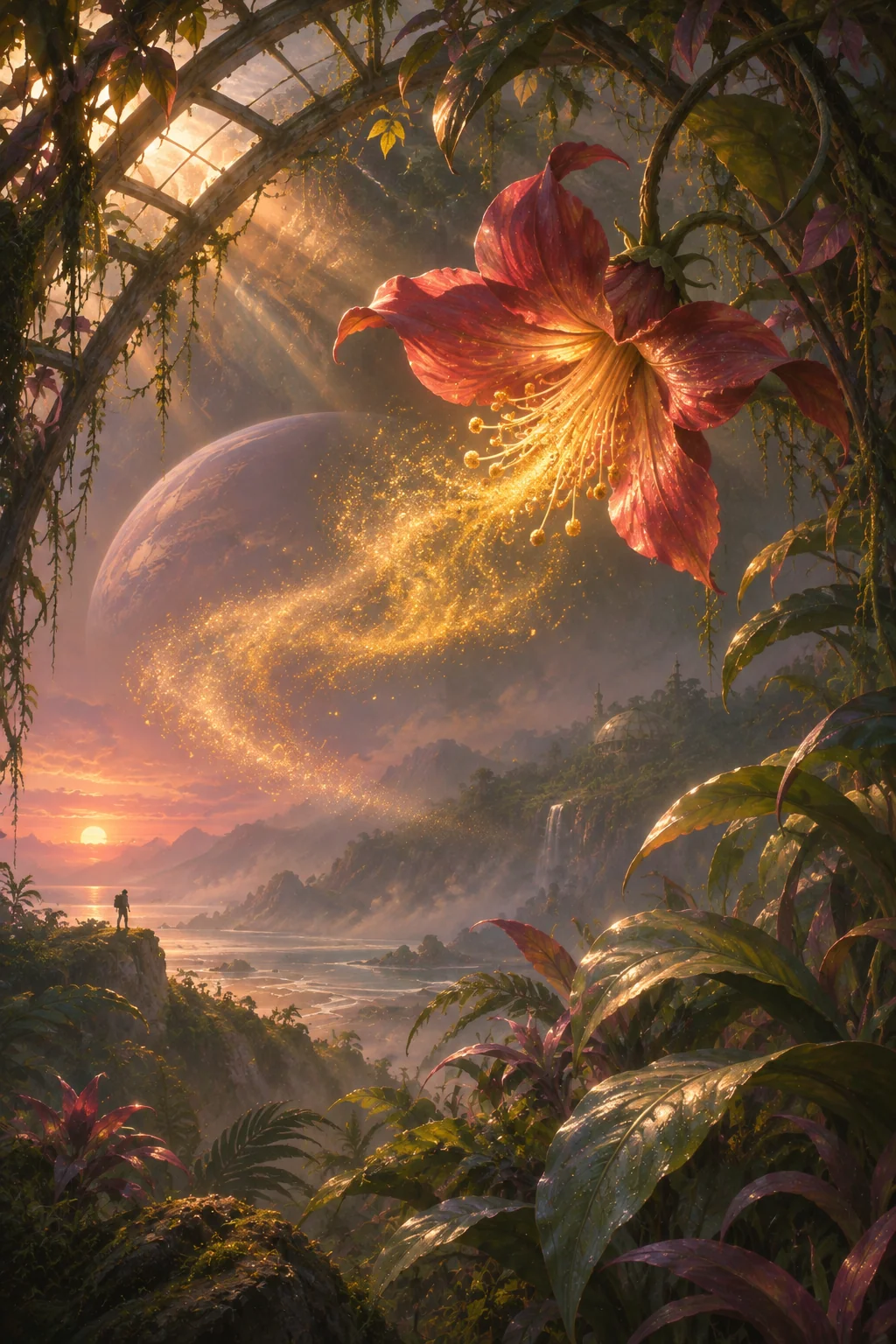
At its tip is a large red flower, somewhere between a lily and a tropical tulip. Its petals are elongated, with sharply defined tips and an elegant, almost sculptural shape.
The entire process happens astonishingly quickly.
Within perhaps five or ten seconds, the stem grows, turns toward me, and positions the flower directly in front of my face.
Then its petals open.
A fine golden powder begins pouring out.
The afternoon sun is now low, illuminating the greenhouse with a warm, slanting light. Against this golden background, the pollen is exceptionally beautiful, drifting slowly through the air in a shimmering cloud.
We stare at it, mesmerized.
Then, in what I recognize even at the time as a rather unprofessional decision, I turn to my colleague.
“Hey, I know it’s not very professional and there is a risk, but I really want to smell what this pollen is like.”
We both laugh.
I lean forward and take a deep breath.
A moment later, he does the same.
The fragrance is wonderful.
Sweet, soft and distinctly vanilla-like.
Almost immediately, I feel a pleasant relaxation spreading through my body.
Then something changes.
My head begins to spin.
The edges of my vision lose a little of their sharpness, and I become aware of a growing lightheadedness.
Oh, fantastic.
We’ve just inhaled an unknown substance produced by an organism we’ve never encountered before, on an isolated island where an entire human colony mysteriously disappeared.
And now we’re getting high.
With sunset approaching, we still have to navigate our way back through the forest to the expedition’s landing site.
I am thoroughly annoyed with myself.
But before I can devote much more thought to my own stupidity, something extraordinary happens.
A figure appears in front of me.
Or rather, the outline of a figure.
It is vaguely humanoid, entirely transparent, with a delicate prismatic glow tracing the edges of its form.
It looks almost like the popular depiction of a human aura, shimmering with faint, multicolored light.
And then I hear a voice.
Except I don’t actually hear it.
There is no sound entering my ears.
The communication occurs directly inside my consciousness, as though ideas and meanings are being placed into my mind without passing through language.
It is the strangest sensation.
If telepathy exists, I think, this must be what it feels like.
The presence is calm, focused and distinctly masculine in character. Although I somehow know it represents the collective intelligence of the vegetation around us, it doesn’t feel like thousands of minds speaking simultaneously.
It feels like one coherent, thoughtful individual.
And it begins to explain.
“Don’t worry. This is the form we have chosen to present ourselves in, as it is the closest to your own. We are the collective mind of the plant life that you see around you. We mean you no harm, but the people who were here before you did not understand that.
“With time, as they were settling here, they too, just like you did today, started to realize that many of the plants on this island are conscious and are communicating with each other and the world around them. They saw that we were not mere inanimate objects, but complex, intricate and intelligent systems.
“Many of the pioneers, however, could not process that information and instead became very scared. They proceeded to violently chop us down, burn and uproot us. They were relentless and never heeded our calls to stop, as we were just here to help and serve them.
“We had no choice at that point. We had to defend our ecosystem, and thus we quickly evolved neurotoxic poisons, spikes, spores and any other possible defensive measures with which we retaliated, overwhelming them completely.”
The voice pauses for a few seconds.
“Almost no one is left here now…”
I stand motionless.
Partly because of the extraordinary effects of the pollen, and partly because I am struggling to process the sheer magnitude of what I have just learned.
The vanished colony.
The abandoned city.
The intelligent grass.
The strange moss.
An entire ecological system capable of consciousness, communication, and coordinated defense.
And a human society that had apparently tried to destroy it.
I am too astonished to form a proper moral judgment about what happened here. Yet something in me instinctively sympathizes with the forest. If its account is true, it had been defending itself against a threat to its very existence.
I glance briefly at my colleague. He appears just as absorbed in the experience as I am, and I have the impression that he is perceiving the same extraordinary presence. But my attention is so completely occupied that I cannot be certain.
There is hardly time to think about it.
In a moment of almost comical scientific reflex, I reach for my recording device.
I activate the camera and point it toward the glowing figure.
I must document this.
I must capture every detail.
Then, of course, I realize how utterly ridiculous the exercise is.
The apparition isn’t actually standing before my eyes.
It’s a construct appearing directly in my mind.
All I’m recording is an empty greenhouse.
Wonderful.
I’m getting high on alien flowers and filming absolutely nothing.
Before I can switch off the device, I hear footsteps behind us.
Then a shout.
I turn around.
It’s the farmer from the camper.
The same man with the large straw hat.
Only now his face is contorted with panic and rage.
He’s charging straight toward us, holding what appears to be an axe or a large knife.
There is something almost primal about his expression.
Not the calculating aggression of someone who has planned an attack, but the desperate reaction of a terrified man who believes something precious is about to be destroyed.
Naturally, I have no time to contemplate his psychological state.
My colleague and I run.
Whatever intoxicating effects the pollen had been producing are instantly overwhelmed by adrenaline.
We sprint out of the greenhouse, through the abandoned playground, and into the jungle.
We retrace our path as quickly as possible, pushing through the vegetation and following the increasingly familiar route toward the coastline.
Oddly, the journey back seems substantially easier than the journey in.
The forest doesn’t appear to obstruct us, and the path seems almost to open ahead.
Whether this is because we’re now familiar with the terrain or because something else is happening, I cannot tell.
We don’t stop to investigate.
By the time we reach the landing site, the sun is almost at the horizon.
The rest of our expedition is already preparing to depart.
We practically throw ourselves into our shuttle.
“Go! Get us out of here!”
The doors close.
The engines engage.
And within moments we are lifting away from the island.
Only once we’re safely airborne do I begin to relax.
I settle into my seat, fastening the restraints, and gaze through the window at the fading sunlight.
The strange purplish tones of the morning have given way to the warm colors of sunset.
And suddenly, everything falls into place.
The farmer.
His wife.
The children.
Their isolated existence.
His insistence that we take no photographs.
The strange statement that they lived on whatever the forest was kind enough to provide.
They were almost certainly among the few survivors, or descendants of survivors, of the original colony.
And they had survived because they had learned to coexist with the vegetation rather than fight it.
The farmer had known exactly what was hidden in that forest.
He had probably followed us from his home, hoping to ensure that we discovered nothing capable of exposing its secret.
And when he saw me attempting to record what was happening, he must have assumed that we had discovered the truth and were about to bring the outside world back to this island.
Back to study it.
Back to exploit it.
And perhaps, eventually, back to destroy it.
His attack was not driven by hatred of us, but by terror of what our discovery might unleash.
For the first time, I genuinely understood his fear.
I glance toward my colleague.
Somewhere in his backpack is the small glass jar containing our sample of iridescent moss.
We still have it.
A physical specimen of something that could transform our understanding of biology, intelligence and consciousness.
There is no question of destroying it. Perhaps someday we might find a way to study it discreetly and responsibly, although even that would be difficult without attracting attention.
For now, it must simply remain safe.
My colleague looks back at me.
Neither of us says anything.
Perhaps some residual effect of the pollen is still facilitating a connection between our minds. Or perhaps, after everything we’ve experienced together, words are simply unnecessary.
We understand each other perfectly.
There will be no report about an intelligent forest.
No announcement of a conscious ecosystem.
No scientific sensation that brings thousands of researchers, journalists, corporations and eventually entire industries to this place.
It isn’t that I’m disappointed in humanity.
It’s simply an acceptance of where we are.
We are not yet mature enough, collectively, to encounter something like this without trying to possess, control or exploit it.
Perhaps one day we will be.
But not today.
Behind me, the other scientists are growing increasingly impatient.
They want to know what we discovered.
Why we returned so late.
Why we looked so frightened when we boarded the shuttle.
I lean back in my seat.
Outside, the final rays of sunlight are disappearing over the horizon.
Then I turn toward the others, smile, and answer:
“Nothing, we just got high off a wicked strong Lilium plant and freaked out. That’s all. Was way better than regular weed, though.”
Everyone laughs.
And we fly home.
❧